 Juan David Lipez
One frame of the wrong value
Anything the server cannot know, such as the time, the theme, or a flag in
sessionStorage, renders with a placeholder and gets corrected on hydration. The
correction lands after the first paint, so the wrong value occupies at least one
frame. Ethan Niser named that a snapsnap, and at 60Hz one frame is 16ms, long enough to notice and too short for anyone to go profiling.
Sign in until React hydrates. The bottom one is the hook this article is about. Production build, CPU throttled 10x.On a fast laptop the window is around 14ms, which is short enough to survive review. Throttling the CPU makes it measurable.
What does not generalise
The fix Niser describes in
a clock that doesn’t snap
has four pieces. An inline <script> goes immediately after the element it
affects. The parser reaches it long before React hydrates, and it patches the DOM
with the real value. It then leaves that value in a global,
window.__INITIAL_TIME__. React reads the global from the useState initialiser.
Those last two pieces are what avoid a hydration mismatchhydration mismatch, which is React picking up the server’s markup, finding it does not match what it just rendered on the client, and saying so in development, and they are also the
ones that do not survive the trip. They work because one person picked
__INITIAL_TIME__ by hand, for one value, in one component.
Suamox packages this as useClientValue,
where a page has as many invocations as it has calls, and every one of them needs
a key that the server and the client derive the same way.
Deriving a key both sides compute
useId() looks like the answer, since React already hands out identifiers that
are stable across server and client. The logs said otherwise, reading _R_3_
during hydration and _r_0_ on a later render. The router remounts the tree
instead of re-rendering it, and a positional id changes between mounts, so one
client-side navigation was enough for the precomputed value to stop being found.
If a positional id will not do, derive the key from the content instead.
resolve.toString(), hashed. It survives remounting and it ignores position in
the tree. It passed the unit tests. It passed the end-to-end tests. It was broken
in production.
SSR bundle:     getItem("idUsr")   ->  cv86gbue
client bundle:  getItem(`idUsr`)   ->  cv14jxbdi
The minifier rewrites the body of the function, and there are two bundles, minified separately and with separate decisions. That is how the double quotes became backticks on one side and stayed put on the other. Two hashes, no match, and React silently falls back to the server value.
Three things kept it hidden:
- The inline script still patched the DOM correctly, so the screen looked right.
- React does not report hydration mismatches in production builds.
- The end-to-end tests asserted on the DOM and never on React’s state, which made them green while testing nothing.
None of that is an implementation bug. Any key derived from the source of
resolve is fragile by construction, because the string being hashed is
serialised from one bundle and compared against another. The original never runs
into it. Its script is written by hand, in the same file, under a global whose
name is fixed.
Removing the key entirely
The fix was to drop the last two pieces. The value stops travelling from the script to React:
const noSubscribe = () => () => {};

return useSyncExternalStore(noSubscribe, resolve, () => fallback);
The server returns fallback through getServerSnapshotgetServerSnapshot, the third argument of useSyncExternalStore, which React calls on the server and then once more on the client for the hydration render, so both sides start from the same value. The client runs
resolve on its own, in its own bundle. The inline script no longer carries
anything, it just moves the DOM correction ahead of the first paint.
With nothing to match, the key, the hash and window.__PREHYDRATE__ all go away,
and with that last global goes one way in for DOM clobberingDOM clobbering, where a <div id=“X”> anywhere in the page creates window.X and quietly stands in for whatever the framework stored under that name.
A script that fails now costs a flicker instead of a wrong value. A CSP that
blocks inline scripts, a client-only route, a resolve that closes over something
from the component scope: every one of those degrades rather than breaking.
What suppressHydrationWarning costs
Patched elements now disagree with React during hydration. React never sees the
server’s HTML again; what it compares against is its own first render, the one
useSyncExternalStore builds from getServerSnapshot so that it reproduces the
server. It walks the already-corrected DOM, finds that render does not match, and
prints the diff:
<button id="btn-logout"
+   hidden={true}    what React renders while hydrating
-   hidden={null}    what the script already put in the DOM
suppressHydrationWarning on those elements silences it, and it is not part of
the hook’s API. It is not required either. Leave it off and the value still ends
up correct, because the store re-renders the moment getSnapshot disagrees with
getServerSnapshot.
The DOM cannot settle that, since the script patches it either way. Ask React
instead, through a value it renders and a render forced after hydration, and the
unmarked elements come out identical to the marked ones. won't be patched up
covers the hydration pass, not the node itself. What the attribute costs is one
console error in development and nothing in production.
The framework cannot add it for you. React reads suppressHydrationWarning off
the element’s props and not off the DOM, where an inline script setting the
attribute changes nothing in any of the four spellings worth trying. Only
whoever writes the JSX can put it there.
That same re-render also covers anything outside patch. A <p> whose text
depends on the value is never touched by the script, so it ships with fallback
and React corrects it on the re-render, which is late by definition. Measured at
6x throttling, the patched button corrects at 192ms and the first paint lands at
196ms, while the text does not move until 620ms.
// Correct after 620ms, so wrong for 424 of them.
<p>{isLoggedIn ? 'inside' : 'outside'}</p>
So the rule holds. Everything that depends on the value goes through patch,
because whatever stays outside it flickers.
Measuring the window
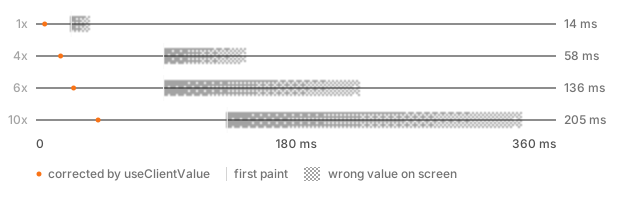
Emulation.setCPUThrottlingRate. Exact milliseconds move between runs and between pages. The shape does not.The bar is the interval where the wrong value is on screen. The hook does not shorten it, it removes it, because the correction happens while the parser is still working through the body.
That holds up to a point. The script sits at the end of <body>, and at 20x,
three loads out of ten painted before the parser reached it. The result is the
failure the design was built for, a flicker rather than a wrong value, so nothing
breaks. But the ordering is not guaranteed above 10x on this page.
The API
useClientValue<T>(
  fallback: T,
  resolve: () => T,
  patch?: { show?: string; hide?: string } | ((value: T) => void),
): T
const isLoggedIn = useClientValue(
false,
() => !!sessionStorage.getItem('idUsr'),
{ show: '#btn-logout', hide: '#btn-login' },
);
<button id="btn-logout" hidden={!isLoggedIn}>Sign out</button>
<a id="btn-login" hidden={isLoggedIn}>Sign in</a>hidden is doing real work there. An earlier draft used a data-cv-hide
attribute with a stylesheet the framework injected into every page, and it forced
this on anyone writing a component:
<button data-cv-hide={!isLoggedIn || undefined}>React serialises data-* attributes by value, so data-cv-hide={false} reaches
the HTML as the string "false", and a [data-cv-hide] selector matches any
value, that one included. The button would hide unconditionally, and that
|| undefined exists for no reason other than forcing React to omit the
attribute. React knows hidden as a boolean attribute and omits it on false by
itself, and the global stylesheet goes away with it.
The catch is that hidden loses to any rule setting display on the element,
which plenty of CSS frameworks do. Restyling the demo to record the clip above
was enough to trigger it, with one display: inline-block on the buttons making
both of them show at once. The fix is a line, and only the pages that need it pay
for it.
[hidden] { display: none !important; }resolve carries most of the restrictions. It is used two ways, and only one of
them constrains what you can write. React calls it like any other client function.
The inline script serialises it with toString(), and that copy runs with no
imports, no component variables, no module constants and no .bind(). It also
ends up in public HTML, so nothing secret goes in it.
What generalising changes
The original works, and it keeps working for the case it was written for. Two things change on the way to a framework.
A key derived from the source of a function cannot survive two bundles minified
separately, which rules out the solution that looks most obvious. And letting the
client recompute with useSyncExternalStore, while demoting the inline script to
a paint-time optimisation, turns every failure into a flicker rather than a wrong
value. That leaves the flicker as the only thing left to account for, and it is
not confined to the elements listed in patch.